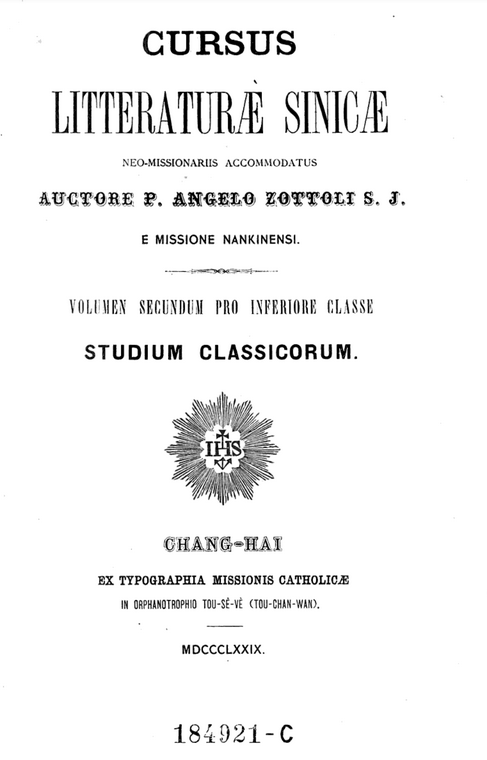
Cursus litteraturae sinicae

Bibliographic Data

Item details
Thumbnail Cursus litteraturae sinicae
Full Title Cursus litteraturae sinicae neo-missionariis accommodatus
Year 1879
End Year (multi-year Work) 1882
Translator(s)/Commentators(s) Zottoli, Angelo
Book Type Print
Language(s) Latin
Chinese Text Characters and transliteration
Place Of Publication Shanghai
Publisher's Imprint Chang-Hai ex typographia missionis catholicae in orphanotrophio Tou-Sè-Vé (Tou-Chan-Wan)
Physical Description

5 volumes:

  1. Volumen primum pro infima classe. Lingua familiaris (Volume one for the lowest class: The colloquial language). viii + 904 pp.  Published in 1879; reprinted by the same press in 1909 as a "Nova Editio" (Also translated into French by P.C. de Bussy, S.J., and published at T’ou-sè-wè in 1891.
  2. Volumen secundum pro inferiore classe: Studium classicorum (Volume two for the lower class: Study of the classics). vii + 655 pp. Published in 1879; reprinted in 1915 as a "Nova Editio"
  3. Volumen tertium pro media classe: Studium canonicorum (Volume three for the intermediate class: Study of canonical texts). xxiv + 768 pp. Published in 1880.
  4. Volumen quartum pro suprema classe: Stylus rhetoricus (Volume four for the highest class: Rhetorical style). xix + 820 pp. Published in 1880.
  5. Volumen quintum pro rhetorices classe: Pars oratoria et poetica (Volume five for the class in rhetoric: Section on oratory and poetry). xi + 840 pp. Published in 1882.
Later Editions/Reprints

Angelo Zottoli, Volumen secundum pro inferiore classe: Studium classicorum, nova editio, 1915

Summary

Latin translations of the Confucian classics are found in volumes 2 and 3.

Sources

Item details
Classical Source(s) Great Learning (大学)
Doctrine of the Mean (中庸)
Analects (论语)
Mencius (孟子)
Classic of Poetry (诗经)
Book of Documents (书经)
Book of Changes (易经)
Book of Rites (礼记)
Spring and Autumn Annals (春秋)

Bibliography

Item details
Secondary Sources

Williams, Nicholas Morrow, 2015. "Angelo Zottoli's Cursus litteraturae sinicae as Propaedeutic to Chinese Classical Tradition", in Monumenta Serica, 63, 327-359.

↑